
Just as my own father named my elder brother after a friend he had flown with in the war, so I named my own firstborn after my closest mucker during a time of similar adventure, fear and upheaval. It was with great sadness, therefore, that through the In Memoriam section of my college magazine dated December 2025 I learnt of the death of my great and variously gifted friend Peter Reynolds (7/10/1954–29/5/2025). Although it had been some years since I last communicated with him (he was doing something corporate in Australia – the job surprised me, the location didn’t), he had been the first close friend I made at St John’s when we both went up to Oxford to read Modern Languages in 1974.
It was immediately clear to me that Pete was a living exemplar of Jack London’s words as quoted in the James Bond film No Time to Die (2021): “The proper function of man is to live, not to exist. I shall not waste my days in trying to prolong them. I shall use my time.” And boy, did Pete use his. Maybe not always in the ways our dear tutors would have wanted him to, but they had their agenda and my Rabelaisian friend had his. During those first trembling weeks of that momentous Michaelmas Term, he showed me that I was still taking life – and especially myself – far too seriously. He was in it for the thrills and the spills, the laughs and the larks, and in no time at all I had become his eager and devoted disciple. A quivering introvert when I first came up, by the end of the summer term, I was acting in revues.
Although I always felt like the prim Nick Carraway to Pete’s glittering Gatsby (actually, since this was the grotty ’70s, a more accurate visual parallel would probably be Withnail and I), his influence on me was similarly instantaneous, profound and irreversible. Quite apart from being the inspiration for my very first stage play, he went on to feature in at least one novel, a comedy book, and a short story. Some of these at least, I’m happy to say, he even got to read. He was very forgiving.
We could not have been more different in background, attitude, outlook, or character. He was my first public schoolboy, for instance – Wellington, if memory serves – but he didn’t have a pompous bone in his body, and his cheerful acceptance of my provincial shyness was a constant reassurance. We used to take tutorials together and our beleaguered tutor once described him as ‘the original cheeky chappie’. But he was lot more than that.
He had an appetite for experience and a taste for danger that I found enthralling and alarming in equal measure. I had my first motorcycle ride on the pillion of his dirt bike. He gave me my first puff of weed (though I did not, of course, inhale). And he was the first person I ever got drunk with – in fact, it was he who spiked my lemonade and lime in the Lamb & Flag after our Finals to make sure I would be. And of course, his girlfriends were to die for – so I did, constantly and hopelessly. I spent a lot of time smiling winsomely at them, hoping to pick up any crumbs from the great man’s table, though this only shows my naïveté: if they were there for the bad boy, they weren’t likely to look twice at the quivering simp on the side. And so it proved.
In matters of art his instincts were sound. In our first year he admired a couple of sixth-form paintings I had on my wall and offered to buy one off me. No one had ever done that before. “How much?” I asked in astonishment. “Mate, if I paid you what I think it’s worth,” he said winningly, “I couldn’t afford it.” Like I said, irresistible. So I let him have my elegant pastel of a rich woman in a white gown sitting in the back of a Rolls-Royce with a couple of dogs for two pounds, at a time when two pounds could actually make a difference. He introduced me to Keith Jarrett’s improvised piano masterpiece The Köln Concert which I have not stopped playing since, and once he even hired a little black and white TV for his room and we spent many late nights together, peering through the Marlboro fug, catching up on classic movies. Once Upon a Time in the West was a favourite. Another was the French weepie Un Homme et Une Femme. Pete, of course, that dangerous romantic, had most of the seductive dialogue off by heart.
If he was not above using his friends, he did so on strictly Marxist lines – to each according to their needs, from each according to what they could afford. He once woke me up to introduce me to a new girlfriend, and I remember standing there in my dressing gown at two in the morning singing them my latest songs, like a kind of royal command foreplay. On the other hand, much later, when another of my spontaneous party concerts went badly and I made a complete arse of myself, it was Pete alone who stayed behind and asked for an encore. And one night very late, doubtless returning from his latest secret mission in the service of his country, or the most recent international debauch – I never knew quite how he filled his private hours, and decided early on that it was probably best not to speculate – he crept into my room to crib our latest essay due in that morning. When I woke up a few hours later I found him slumped in my armchair, asleep over the discarded pages, snoring delicately. It was good to know that the soporific power of my writing style had managed to afford him a few hours of restful and evidently necessary slumber.
It was probably inevitable we would go our separate ways after Oxford, as I had finally grown out of my schoolboy crush and had even managed to find my way to a few rather choice girlfriends of my own, and by then we had little other than our faculty and our friendship in common. But he remained, for me, unforgettable. I shall miss him, both as a man, and as a character whose more colourful excesses I so shamefully plundered, and whose exaggerated misrepresentation in my work, I was happy to note, briefly afforded him some small amount of pleasure.
(For further libellous anecdotes based on the doings of the wonderful Peter Reynolds, may I direct you towards The Naff Student’s Handbook, my devil’s guide to university life, whose pages my late lamented friend, like a disreputable japester, under a variety of thin disguises, louchely haunts.)
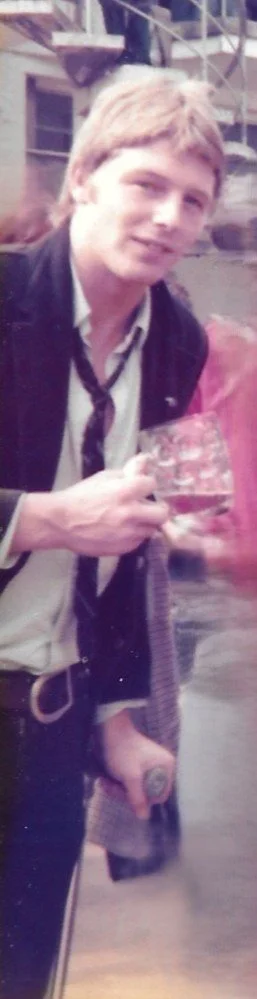
My friend, as I remember him, at some rowing regatta. The pint is obviously de rigueur, though the walking stick was a bit of a statement even for him. He usually managed to escape his scrapes unscathed. Whether the broken ankle on this occasion was the result of saving some small child from a runaway horse, or being chucked out of a bedroom window in one of the women’s colleges, I can no longer remember. It could be either or both. One story he told me, which I recount in The Naff Student’s Handbook, about how he once auditioned for a blue film in Hawaii with his broken leg still in plaster, was probably not true. But I think we both kinda wished it was. Let’s just say I wouldn’t have put it past him.